
Queen Bees
British Queen Breeding in Northumberland
Looking for queen bees for sale in the UK? Our queens are the result of a breeding programme developed in Northumberland through commercial colony selection, controlled breeding, instrumental insemination and daughter testing.
We have been breeding and rearing queen bees in Northumberland since 2015, developing our own breeding populations through successive generations rather than relying upon the repeated introduction of imported breeder queens.
Our breeding decisions are based not simply on pedigree or appearance, but on how colonies and their daughters perform under real working conditions.
For 2027, our principal commercial mated queen is The Northumberland Buckfast — a naturalised, locally adapted British Buckfast breeding population developed through more than a decade of commercial selection.
Buckfast heritage. Native influence. Bred for Britain.

Queen Rearing Is Not the Same as Queen Breeding
Producing a queen in Britain makes her UK-reared.
Developing the genetics behind that queen through successive generations of selection makes her part of a British-developed breeding population.
That distinction is fundamental to what we do.
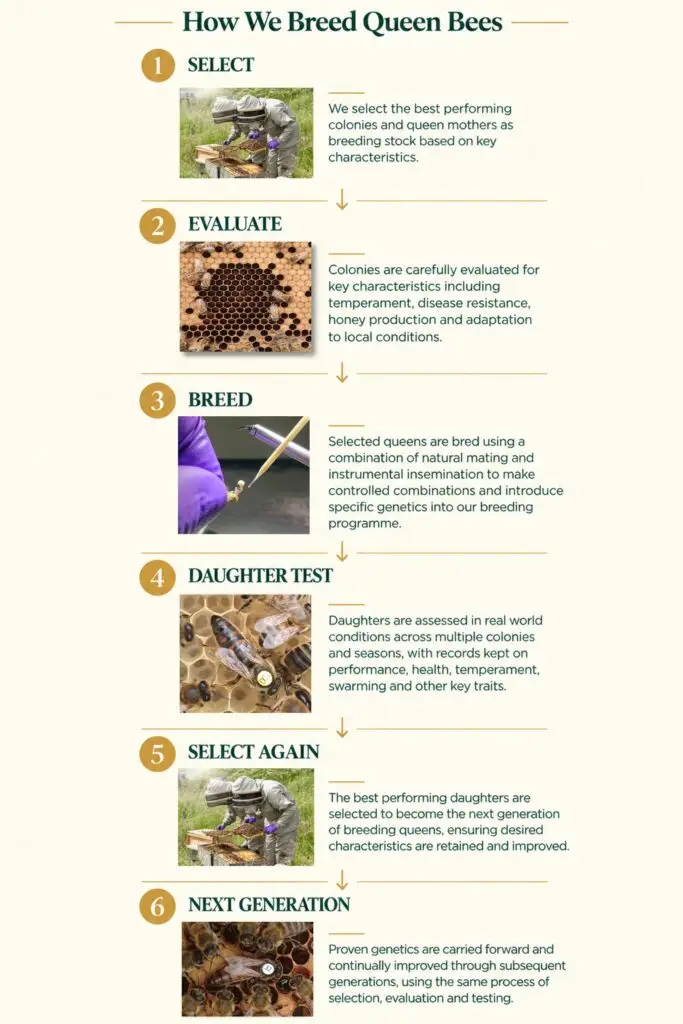
Queen rearing is the practical process of producing new queens. Queen breeding goes further: identifying exceptional colonies, selecting queen and drone mothers, making deliberate matings, evaluating the daughters and deciding which genetics deserve to continue into subsequent generations.
We therefore select both sides of the pedigree.
Queen mothers are selected from colonies demonstrating characteristics we want to retain.
Drone mothers determine the male genetics entering subsequent generations and are selected with the same purpose.
Instrumental insemination and controlled breeding allow particular genetic combinations to be created and evaluated, but pedigree alone is never enough.
A pedigree tells us where a queen came from. Daughter testing tells us whether we should breed from her again.

The Northumberland Buckfast
The Northumberland Buckfast is now the principal commercial population within our queen-breeding programme.
Its ancestry is Buckfast. Its breeding history is distinctly our own.
Our population has been progressively shaped through more than a decade of British breeding and selection, combining established Buckfast ancestry with our own commercial selection, locally inherited genetics and carefully selected influence from our British Black Bee programme.
Our objective isn’t to preserve a particular appearance or an arbitrary genetic percentage. It is to develop bees that perform consistently within our own commercial operation and under British conditions.
What We Select For
- Calm temperament and steadiness on the comb
- Honey production
- Manageable swarming behaviour
- Colony strength and development
- Winter economy and overwintering
- Brood health
- Hygienic behaviour
- Varroa observations
- Performance in difficult weather
- Adaptation to northern British conditions
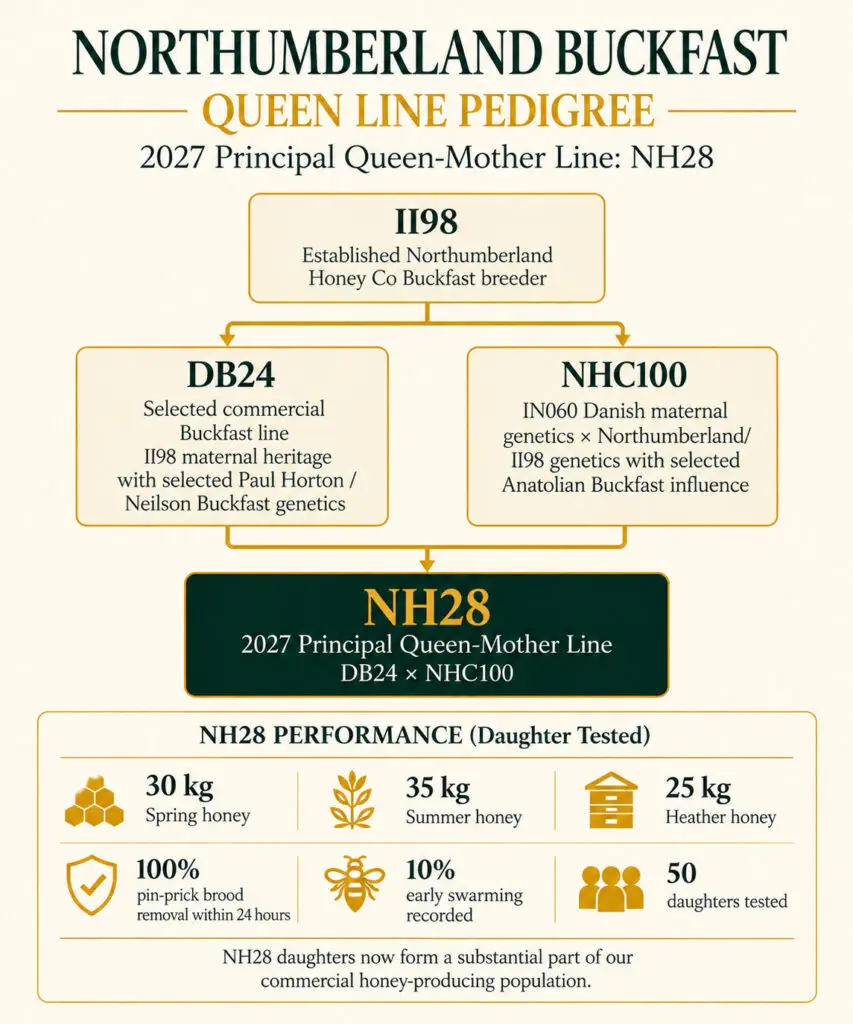
For 2027, our principal queen-mother line is NH28, a daughter-tested line developed from DB24 × NHC100.
Northumberland Buckfast Queen-Line Pedigree
From II98 to NH28
Our current queen-line pedigree represents several generations of breeding and selection rather than a single breeder queen.
II98 became an important foundation breeder within our Buckfast programme. Her genetics subsequently contributed to both sides of the pedigree that ultimately produced NH28.
DB24 combined II98 queen-mother ancestry with selected commercial Buckfast drone genetics originating through Paul Horton and Neilson lines.
NHC100 brought together selected Danish Buckfast queen-mother genetics with our established II98-derived breeding material and selected Anatolian Buckfast influence.
These two branches were subsequently brought together through the controlled combination:
DB24 × NHC100 → NH28
NH28 has since undergone daughter testing within our commercial honey-producing colonies and is our principal queen-mother line for 2027.
Importantly, NH28 is not the Northumberland Buckfast itself.
It is a current breeding line within the wider Northumberland Buckfast population. The population continues to develop as subsequent generations are bred, evaluated and selected.
Daughter Testing: From Pedigree to Performance
A pedigree tells us the ancestry of a queen. It doesn’t tell us whether her daughters will make good working colonies.
Promising breeder queens therefore produce daughters that are evaluated within our commercial operation before their genetics are expanded more widely.
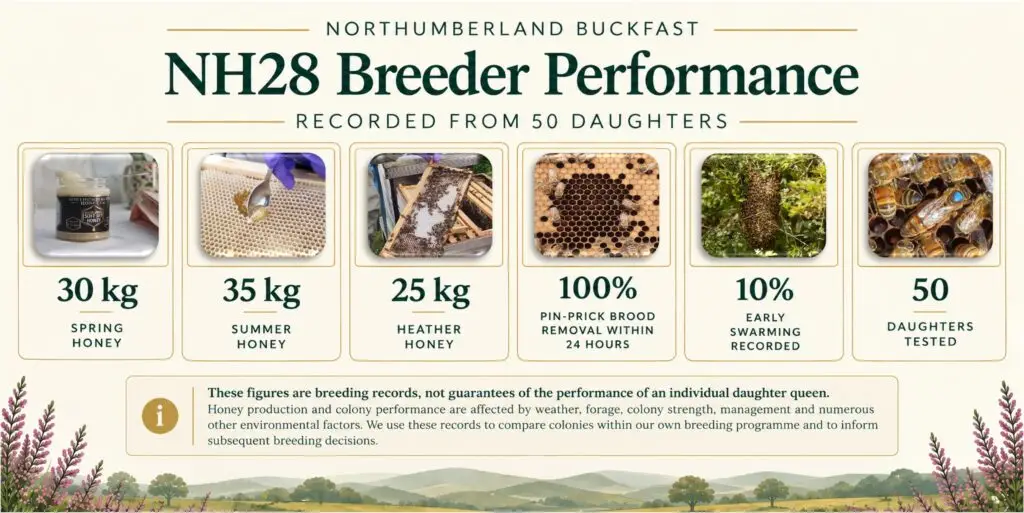
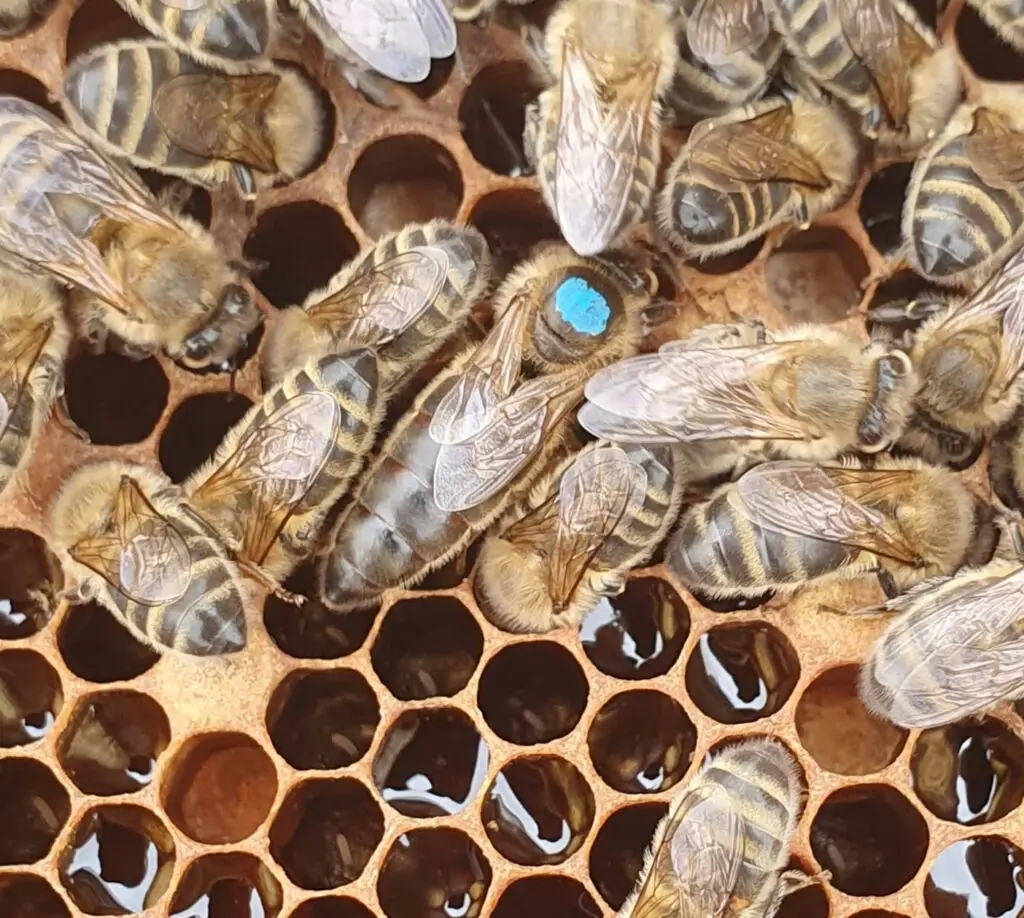
For NH28, 50 daughters have been tested, with descendants now forming a substantial part of our commercial honey-producing population.
Recorded NH28 Breeder Performance
British Black Bees & Native Influence
Alongside our Buckfast population, we have maintained a separate breeding programme working with British Black Bee and Apis mellifera mellifera (Amm) genetics.
This includes locally adapted Northumberland dark bees alongside selected material from other British Amm populations.
Within our own breeding populations, we have identified useful characteristics including frugality, adaptation to northern conditions, performance during difficult weather and valuable genetic diversity. We have also encountered characteristics we have wanted to improve, which is precisely why these populations are evaluated through a breeding programme rather than preserved unchanged.
Our approach has therefore not been to regard Buckfast and British Black Bee genetics as two populations that must always exist in complete isolation.
Where particular genetics demonstrate characteristics that may benefit our wider breeding objectives, we can combine them deliberately, test the resulting descendants and retain useful characteristics through subsequent selection.
One particularly important part of that work involved NH99, our locally adapted Northumberland Amm line.
How Native Genetics Entered Our Buckfast Population
Our established Buckfast breeding material also contributed to NH5, our local foundation Buckfast line.
NH5 originated from II98-derived queen-mother genetics, mated to drones from a genetically diverse, locally inherited survivor population. The resulting population was subsequently selected under Northumberland conditions.
We later used instrumental insemination to make a controlled combination between NH5 and drones from NH99, our locally adapted Northumberland Amm line:
NH5 × NH99 → NHC25
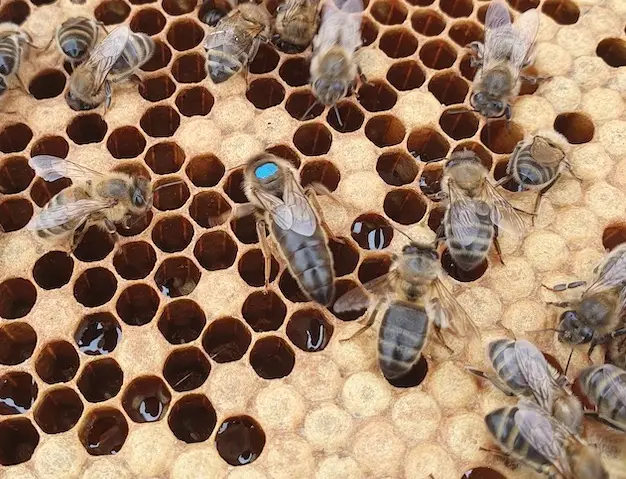
NHC25 was subsequently evaluated within our breeding programme. During the particularly difficult 2024 season, this line demonstrated useful frugality and poor-weather performance, while retaining characteristics we considered valuable enough to continue working with.
NHC25 was therefore retained as a drone-producing line through 2024–2026, allowing selected NH99-derived Amm genetics to contribute to the wider mating population used within subsequent generations of our Northumberland Buckfast.
Is the Northumberland Buckfast a Buckfast × British Black Bee Cross?
No. That would considerably oversimplify its breeding history.
The Northumberland Buckfast is not a simple F1 cross between a Buckfast queen and a British Black Bee drone, nor do we describe it as having a fixed percentage of Amm ancestry.
NH99-derived genetics have entered the population through controlled breeding, subsequent drone selection, open mating and further generations of evaluation and selection.
Those genetics therefore form one part of a much longer breeding history.
Native genetics contribute to the Northumberland Buckfast. They do not define it.
Our British Black Bee Breeding Programme
Our work with British Black Bees continues as a distinct breeding programme alongside the Northumberland Buckfast.
Over the years we have maintained and evaluated a number of dark and Apis mellifera mellifera (Amm) lines, including NH99, H1, NHC90, II NHC101 and Col 1, alongside other locally adapted breeding material.
This work allows us to continue evaluating characteristics within British Amm populations while maintaining genetics that may prove valuable to future generations of our wider breeding programme.
For 2027, we have chosen not to offer Northumberland Dark Queens for general sale. Instead, these populations are being retained within our breeding programme while we concentrate on further selection and development.
Our dedicated British Black/Dark Queen page explains the programme in greater detail, including what we have learned from working with these bees and how selected Amm genetics have contributed to the development of the Northumberland Buckfast
Selection From Commercial Honey-Producing Colonies
Our breeding programme is rooted in working honey-producing colonies.
Potential breeding queens are not selected solely because of their pedigree. They must demonstrate the characteristics we are looking for under commercial beekeeping conditions, and those characteristics must then be considered alongside the performance of their daughters.
We record and evaluate characteristics including honey production, temperament, colony development, swarming behaviour, overwintering, brood health, hygienic behaviour and Varroa observations.
This means selection takes place over time. A colony that performs exceptionally during one season may be interesting, but it does not automatically become breeding stock. We are looking for genetics that continue to demonstrate useful characteristics through their descendants.
Looking Beyond Our Own Apiaries
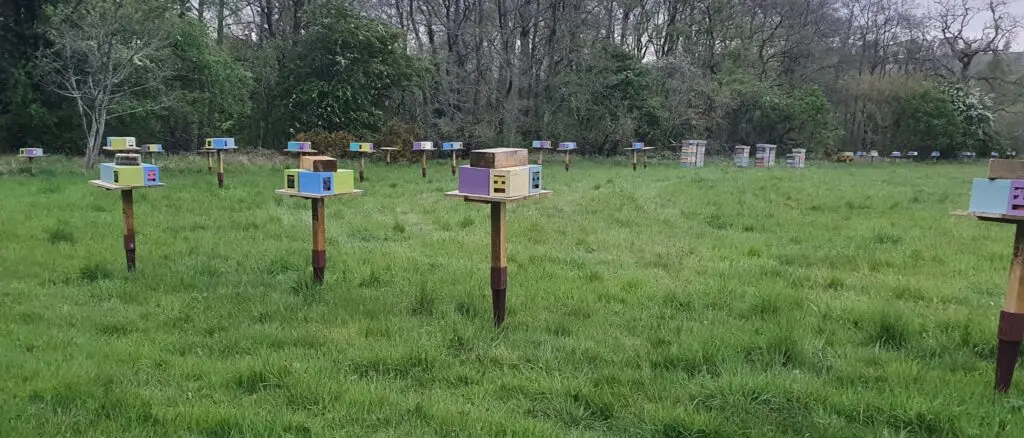
Our own colonies form the core of the programme, but we also maintain long-standing relationships with established British commercial bee farmers.
These relationships give us opportunities to identify particularly interesting colonies and genetics emerging from much larger commercial populations. Selected material can then enter our own controlled breeding and daughter-testing programme in Northumberland.
This creates a much wider pool from which potentially valuable genetics can be identified, while the decision to retain those genetics is ultimately based on testing and selection within our own breeding programme.
Good queen breeding starts with a large population — but progress comes from knowing what to select, what to test and what to retain
Instrumental Insemination & Controlled Queen Breeding
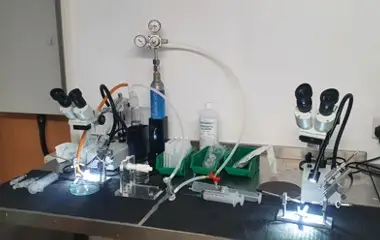
Instrumental insemination allows us to make controlled genetic combinations, selecting both the queen-mother and drone genetics involved in a mating.
We use it alongside natural mating and selected drone populations to develop new combinations, maintain important lines and introduce selected genetics into our breeding population.
The resulting daughters still have to prove themselves through testing. Controlled mating creates the pedigree; performance determines what we retain.
Queen Bees Available in 2027
For 2027, we have deliberately simplified our commercial queen offering so that more of our time can be devoted to breeding, testing and our honey-producing colonies.
Northumberland Buckfast Mated Queens
Our principal queen for 2027. Just 400 mated queens will be released across four scheduled batches from May to August.
British Black / Dark Queens
Our British Black Bee breeding programme continues internally, but Dark Queens will not be offered for general sale during 2027.
Virgin Queens & Queen Cells
These will not be available for advance pre-order in 2027. Small quantities may be released during the season when surplus to our own breeding requirements
Queen Bees Bred in Northumberland
Our queen-breeding programme continues to evolve with every generation.
The aim is not to create a finished or genetically fixed bee, but to maintain a population in which useful characteristics can continue to be identified, tested and improved under British commercial beekeeping conditions.
For us, that means combining pedigree with performance, controlled breeding with commercial testing, and established Buckfast heritage with carefully selected British genetics.
Good beekeeping is all about sharing good genetics.